Illustrative 500,000-product scenario, not a performance guarantee. Large catalogues need more than individual product records. NEKOM supports preparation, enrichment and channel-specific checks for product information.
A large catalogue combines ERP data, supplier lists, images and editorial content. Every sales channel has different requirements. Work that is manageable for a few items becomes repetitive as variants, countries and pricing rules grow.
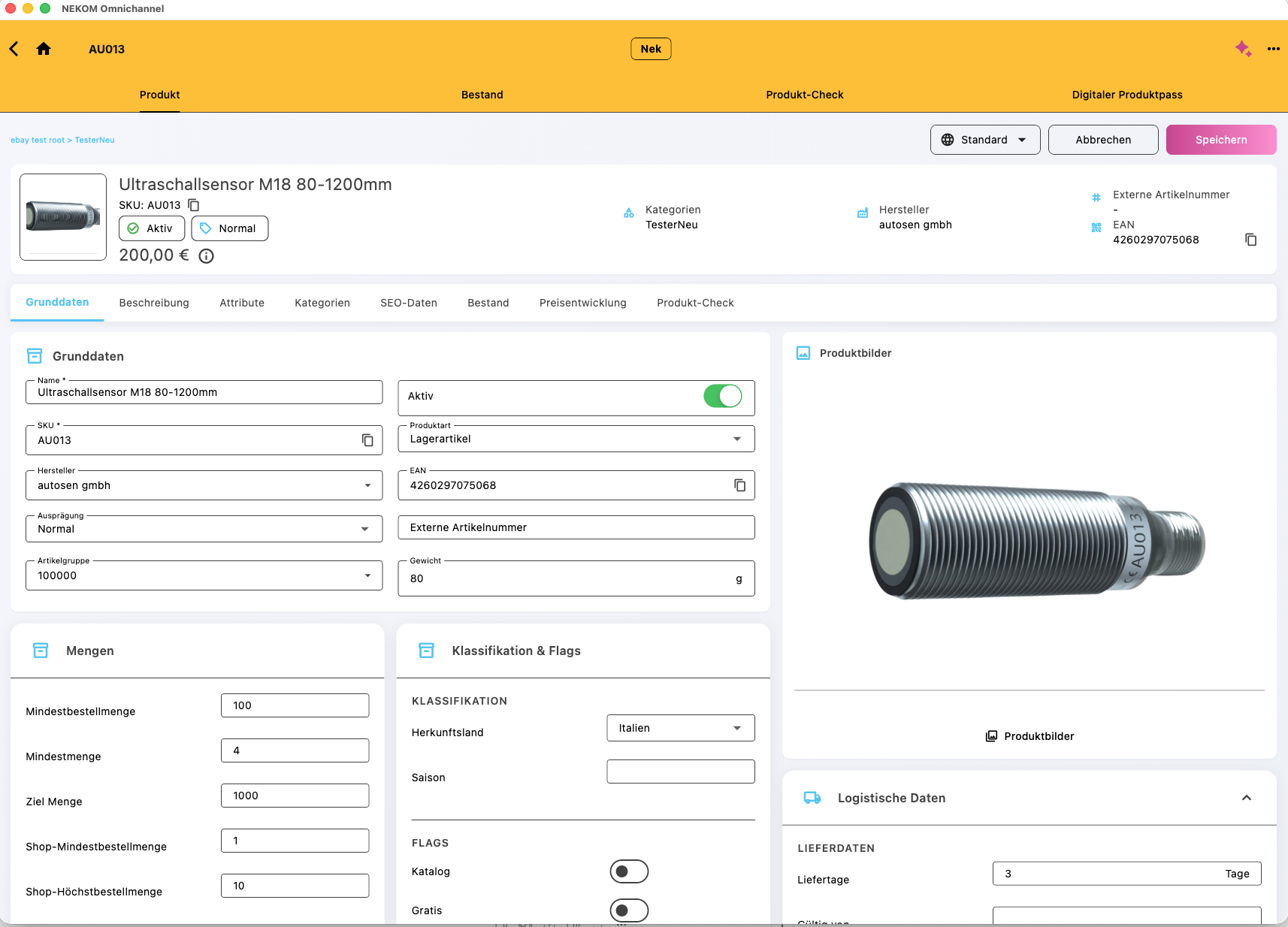
NEKOM PIM · Representative product view. Tabs point to additional areas; their contents are not open in this view.
THE CHALLENGE
Where everyday operations become complex.
A large catalogue combines ERP data, supplier lists, images and editorial content. Every sales channel has different requirements. Work that is manageable for a few items becomes repetitive as variants, countries and pricing rules grow.
Missing attributes, inconsistent descriptions and incomplete translations
Different category structures, complex variants and channel-dependent pricing
Image logic, media, delivery times and availability rules
Time-dependent pricing and different marketplace requirements
WHEN DATA TRANSFER ALONE IS NOT ENOUGH
The rules between systems matter.
An import transfers existing fields. It does not by itself establish whether information is correct or complete for a particular channel. As catalogues grow, rules, data maintenance and checks need to work together. AI assistance does not replace business approval.
HOW NEKOM CONNECTS THE WORKFLOW
Individual systems become an aligned workflow.
NEKOM combines central product records with attributes, variants, categories, prices and assets. Its Rule Engine and supported AI functions for copy, attributes and translation assist preparation. Product Check highlights completeness and channel-specific actions before information reaches configured channels.
01ERP / suppliers / CSV / API
02NEKOM PIM + rules + AI
03Product Check & approval
04Configured stores / marketplaces
Import or maintain product information
Organise attributes, variants, prices, categories and assets
Enrich with rules and AI; review the results
Check channel readiness and missing information
Provide approved data to configured sales channels
Conceptual diagram. Configuration, interfaces and supported workflows are agreed for each project.
THE ACTUAL PRODUCT
What happens after data reaches NEKOM?
Authentic NEKOM application views. The visible information is test data. These views illustrate general functions, not a named customer’s production system.
NEKOM PIM
One product record. One shared working view.
The visible master data includes SKU, name, product type, EAN, manufacturer, category and product image. Tabs lead to attributes, SEO, inventory, prices, quantities and logistics. Not every function is visible in this single open area.
NEKOM PIM · Representative product view. Tabs point to additional areas; their contents are not open in this view.
NEKOM PIM
What is missing before a product is channel-ready?
Product Check makes overall completeness, channel-specific states and required actions visible. The AI summary supports review, with options to inspect individual checks. Business corrections and approval remain part of the workflow.
NEKOM Product Check · Representative view. Completeness values refer to the example product, not general performance metrics.
OPERATIONAL VALUE
More clarity. Less repetitive manual work.
More consistent information across sources
Less repetitive manual preparation
See missing information and actions required
Develop data quality for each channel
For your agency
A shared product information basis supports frontend and channel expansion. Agencies can shape data quality, attributes and checks with their clients rather than rebuilding preparation in each store.
At Paul Wiegand, four people manage more than 100,000 products. That is the specific customer context. The 500,000-product headline is an illustrative large-catalogue scenario, not a verified customer metric or universal capacity guarantee.