Commerce Operations
Connect sales channels
Connect online stores, marketplaces and POS to shared commerce workflows. Manage product information, prices, inventory and status by channel.
Commerce Operations details
Platform
NEKOM connects systems, data and business workflows. Modular by design, built around your existing architecture.
THE FOUR PILLARS OF NEKOM
Commerce, Retail, Product and Service Operations form the four pillars of the NEKOM Business Operations Platform. They connect sales channels to the workflows and systems behind them.
Connect online stores, marketplaces and POS to shared commerce workflows. Manage product information, prices, inventory and status by channel.
Commerce Operations detailsProcess orders centrally across channels. Align routing, order splits, inventory reservations and shipping with warehouse and store systems.
Retail Operations detailsManage variants, attributes and media consistently. Rules, AI-assisted text and translation prepare products for each channel.
Product Operations detailsHandle customer requests, claims and returns in the context of the order. Connect self-service, credits and updates to sales channels.
Service Operations detailsTHE NEKOM ARCHITECTURE
NEKOM forms the central operational layer between your sales channels and existing enterprise systems. Rules, data and workflows connect all four core areas.
Business Operations Platform
The central operational layer for commerce, sales and service.
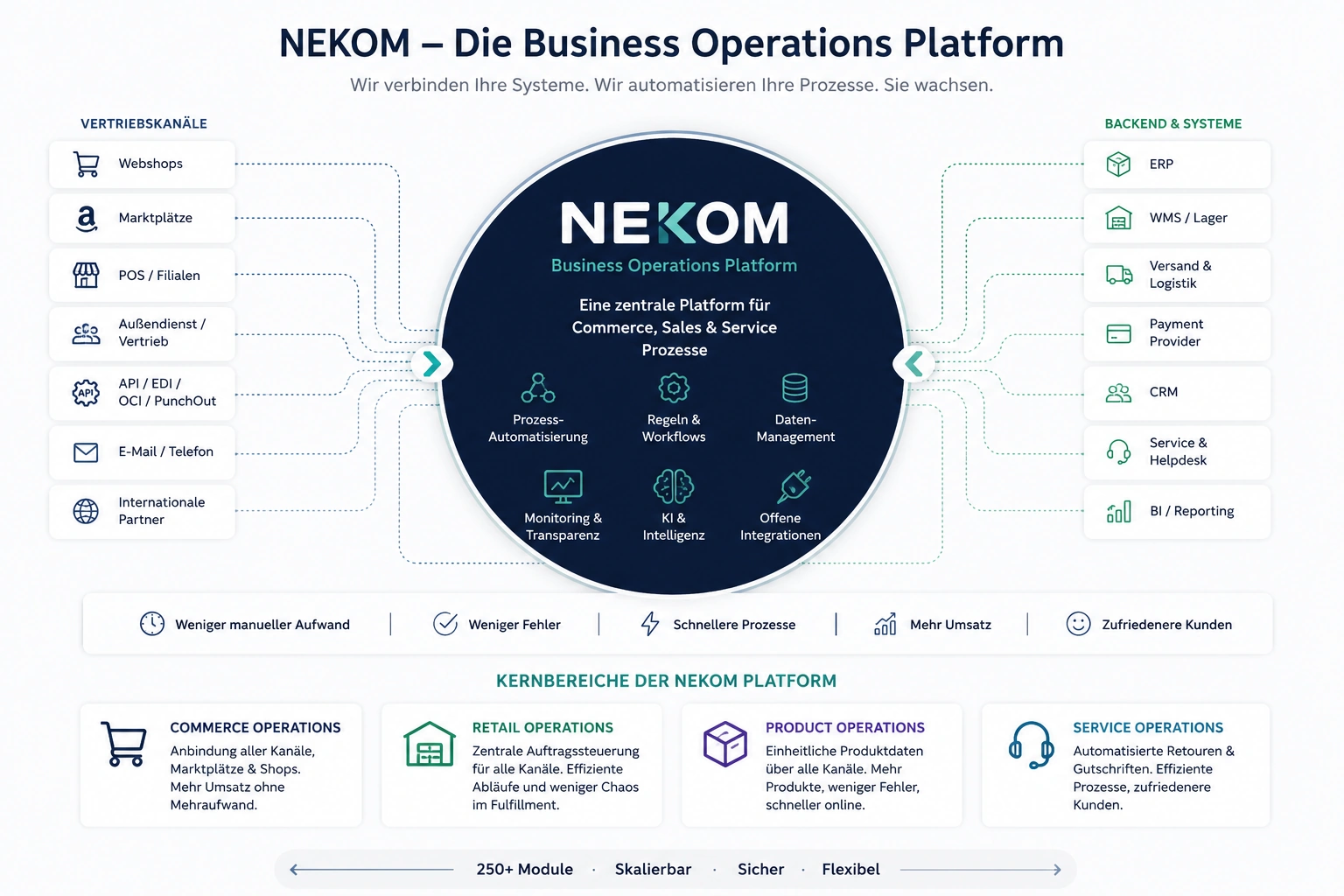
OMS, PIM and WMS cover operational domains. APIs, automation, reporting and monitoring connect and support the workflows.
Process orders from different channels centrally and connect them to ERP, warehouse and service.
02Organise product information for different catalogues, countries and sales channels.
03Bring multiple warehouses and suppliers into connected logistics workflows.
04Create a technical connection between enterprise systems and operational processes.
05Support repeatable data and process steps with defined rules.
06Make operations easier to follow through reporting and monitoring.
INSIDE THE PLATFORM
The existing platform covers more than its core modules. These documented features are used according to system landscape and project scope.
OMS covers channel orders, different statuses and currencies, B2B customer recognition and VAT information. Telephone orders can also enter operational processing. Price lists and customer groups connect product data to commercial terms.
Variants, sets and attributes structure the catalogue. Channel and country prices, price lists and customer groups represent different commercial contexts. Four-eyes approvals support quality assurance. Product Manager adds CSV and API import and export, image processing, rules and AI-assisted text and translation.
Multiple warehouses, picking documents and shipping labels support fulfilment. Supplier portal and dropshipping bring external stock and shipping sources into the process. Returns and credits connect logistics to after-sales. Warehouse or supplier allocation and handovers are defined for each project.
Minimum and target stock levels can support procurement. Supplier purchase orders, delivery dates and goods receipt are considered in the operational context. Relevant data and responsibilities are aligned with existing ERP and purchasing systems.
The platform describes payment service provider connections, reconciliation and release following advance payment. Payment methods, providers and workflows depend on the selected solution and integration.
Documented RISK capabilities include duplicate and address checks, scoring and rules. These support defined review workflows. The rules deployed and decision ownership form part of project design.
Reports and monitoring provide insight into operations. The existing platform description covers inventory, order and payment data, with Excel and API access. Required data, reports and access permissions are agreed for the project.
ADD WHAT YOU NEED
NEKOM also offers individual services. Suitability and combinations are assessed for your project.
Prepare inventory from existing ERP, supplier and POS systems for digital sales channels.
02Import, enrich and prepare product information for commerce using rules.
03Give customers central access to orders and service information.
04Register returns in a structured way and connect handling to downstream processes.
05Categorise customer requests and match them to the right customers and orders.
06Make orders, invoices and shipping information accessible in everyday work.
07Connect a direct ordering channel to NEKOM without running a separate webshop.
08Personal support for using NEKOM and developing operational processes.
FROM REQUIREMENT TO WORKFLOW
Discuss your systems, bottlenecks and next steps with Martin Kahr. Free and without obligation.